Jellyfish Tattoo Fine Line Styles: 25 Dreamy Designs You’ll Want Immediately
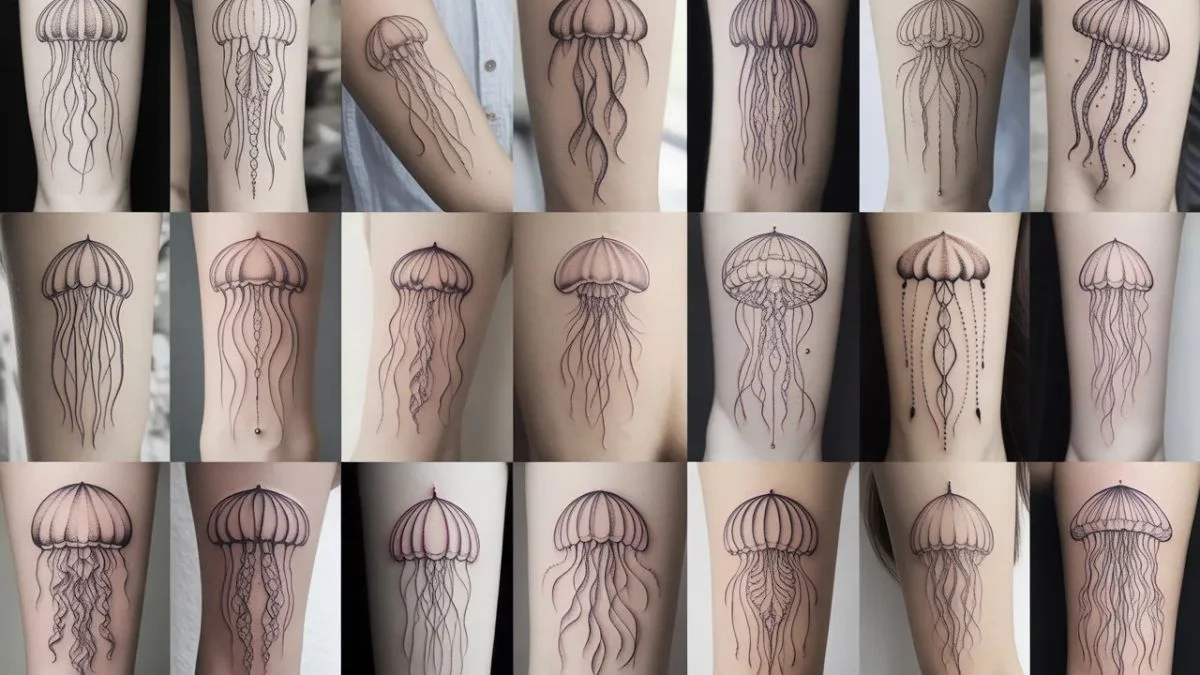
There’s something about a jellyfish that no other creature can replicate — that slow, hypnotic drift, the gossamer trails, the quiet glow beneath the surface. It’s no surprise that jellyfish tattoo fine line styles have become one of the most requested designs walking through studio doors right now.
Fineline tattooing strips every design down to its purest form. No heavy fills, no thick outlines — just the precise, hair-thin marks that turn skin into something that looks more like illustration than ink. And jellyfish, with their organic curves and trailing tentacles, translate into this style better than almost anything else in nature.
Whether you want something tiny enough to hide behind your ear or a flowing piece that wraps your forearm, this guide covers 25 distinct jellyfish fine line tattoo styles — what makes each unique, where they work best, and what to tell your artist.
What Makes Fineline Tattooing Different
Before selecting your design, understanding the technique helps you have a smarter conversation with your artist and set realistic expectations for how your tattoo ages.
Fineline tattooing uses single or tightly grouped needles — often a single needle (1RL) or a 3-round liner — to create lines significantly thinner than traditional tattooing. The result is a soft, almost sketched appearance that sits closer to drawing than conventional body art.
Key characteristics of fine line work:
• Lines typically range from 0.1mm to 0.5mm in width
• Shading relies on stippling, soft grey washes, or negative space rather than solid fill
• High detail is achievable in small formats
• Requires an artist specifically trained in the technique — not all tattooers work this way
• Tends to soften over time as fine lines expand slightly in the skin
That last point matters. A well-executed fine line jellyfish tattoo will still look beautiful a decade later — but it will look different. Discuss longevity openly with your artist and ask to see healed photos of their fine line work, not just fresh pieces.
1. Single-Needle Minimalist Jellyfish
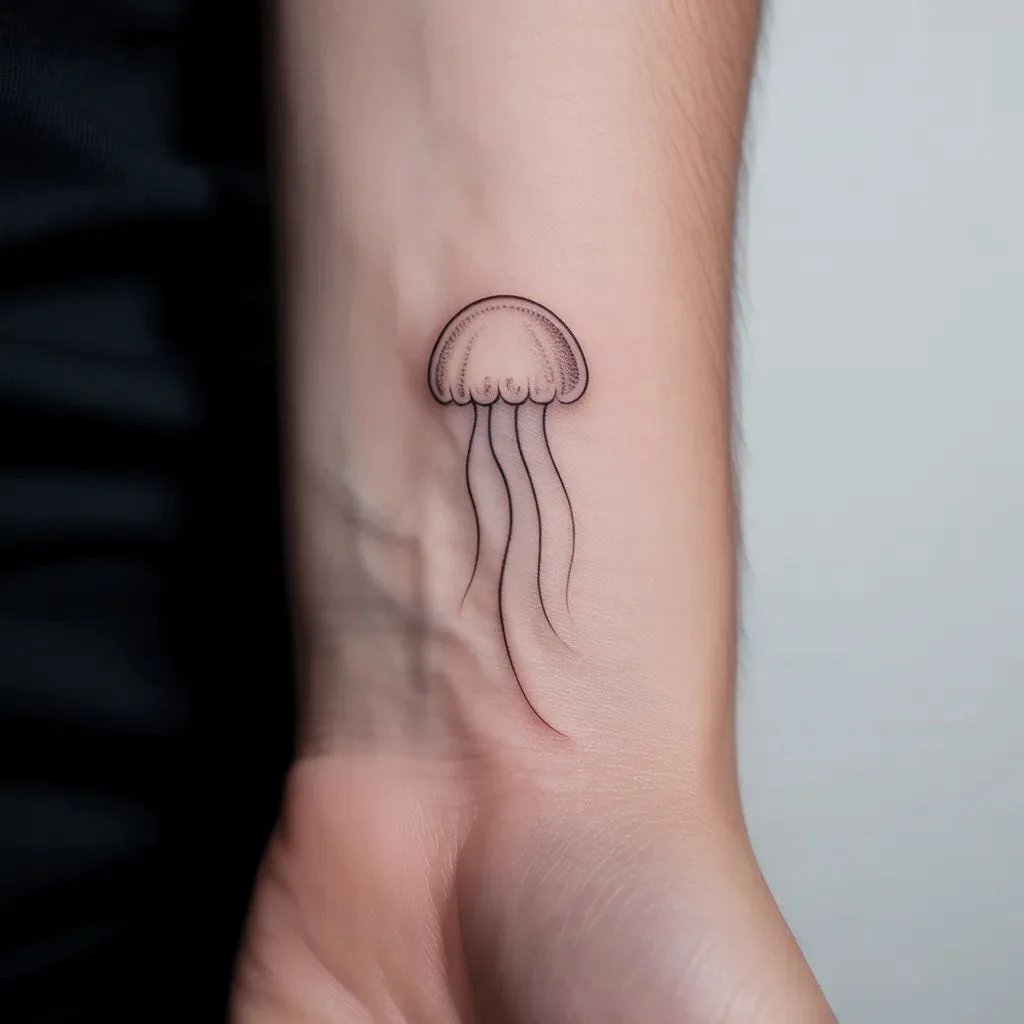
The most stripped-back version of jellyfish tattoos fine line styles, the single-needle minimalist approach reduces the creature to its essential silhouette. A softly rounded bell, three or four flowing lines beneath — and nothing else.
This style works beautifully at small scale: behind the ear, on the inner wrist, or along the collarbone. The simplicity makes it surprisingly versatile; it reads as elegant rather than bare because the subject matter carries its own visual weight.
2. Blackwork Jellyfish with Fineline Detail
Blackwork and fine line are frequently presented as opposites, but skilled artists combine them to stunning effect. A solid blackwork bell — deep, saturated, commanding — paired with delicate single-needle tentacle lines creates a striking contrast between weight and whisper.
The tension between bold and delicate is what makes this design so memorable. It suits people who want impact without committing to an entirely heavy piece. Placement on the upper arm or shoulder gives the design room to breathe.
3. Geometric Fineline Jellyfish
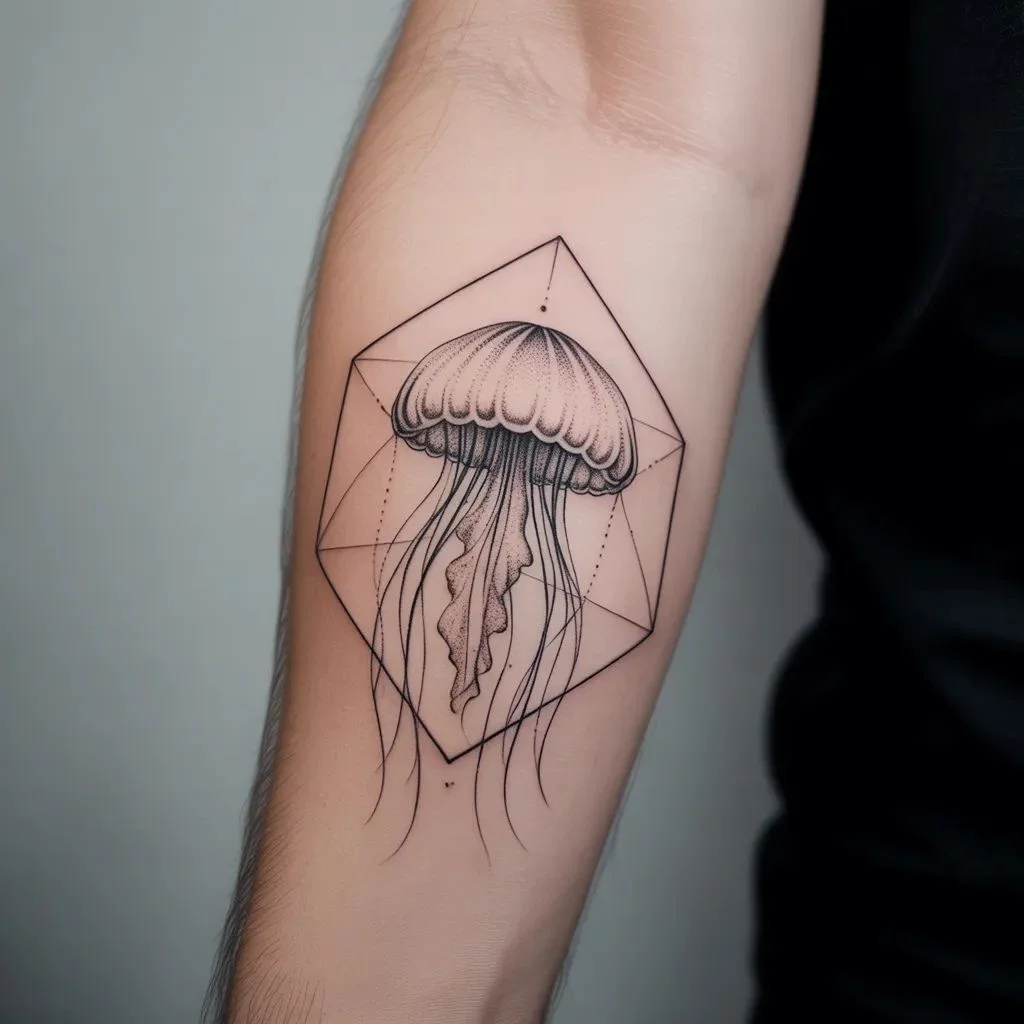
Sacred geometry meets ocean life. In this style, the organic curves of the jellyfish are interrupted — or framed — by precise geometric elements: hexagons, mandalas, dotted circles, or fine grid lines woven through the tentacles.
The contrast between the fluid creature and rigid geometry creates a philosophical tension that appeals to people drawn to meaning in their ink. It’s a design that rewards close inspection; the closer you look, the more structure reveals itself.
Best placement: sternum, forearm, or thigh — anywhere with a relatively flat surface that lets the geometric elements stay crisp.
4. Watercolour-Wash Fineline Hybrid
Here, delicate fine line outlines anchor splashes of soft colour that bleed beyond the edges — as if the jellyfish were dissolving into watercolour paint. Blues, purples, and soft teals are the most popular palette, though some artists work with warm corals and gold washes.
The fine line structure keeps the design readable while the watercolour elements add dreaminess. It photographs beautifully and ages better than pure watercolour tattoos because the linework remains legible even as colour softens.
5. Ornamental and Dot-Work Jellyfish
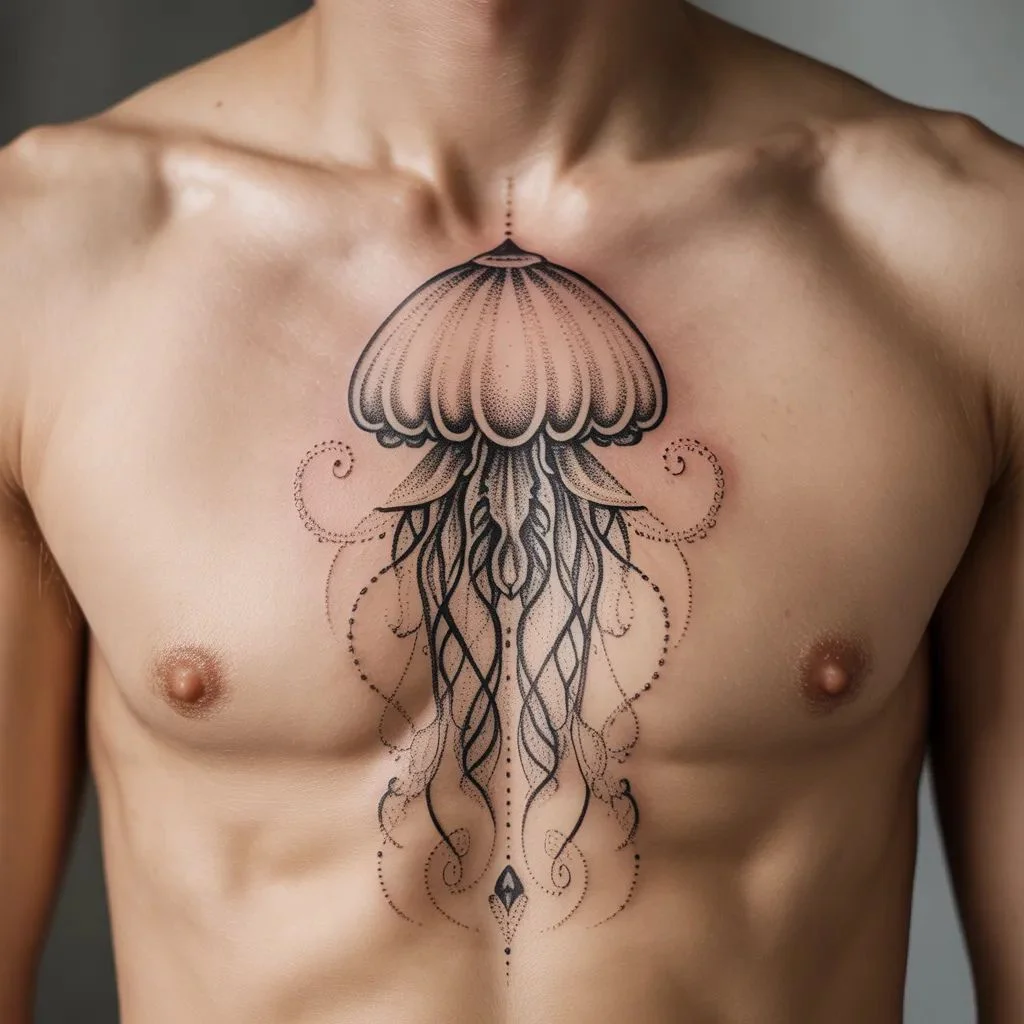
Dot-work — building form through thousands of tiny stippled points rather than continuous lines — suits the jellyfish’s translucent, shimmering quality perfectly. When combined with ornamental flourishes like fine filigree, beading patterns, or mandala elements, the result looks almost like jewellery pressed into skin.
This is a technically demanding style. Look for artists who specifically list ornamental dot-work in their portfolio. The investment is worth it: a well-executed piece in this style is genuinely breathtaking.
6. Micro Jellyfish Tattoos
Micro tattoos have exploded in popularity precisely because they defy expectation. The idea that something so small can carry so much detail — a complete jellyfish with visible internal structure, shaded bell, and multiple trailing tentacles, all within a circle the size of a coin — is genuinely remarkable.
Micro fine line jellyfish work best on:
• Behind the ear or at the hairline
• Inner finger (though longevity here is reduced)
• Ankle or top of foot
• Inner wrist
Be aware that micro tattoos require an artist with excellent technique and premium equipment. They are not smaller versions of regular tattoos — they require a completely different approach to needle depth, ink saturation, and design simplification.
7. Flowing Tentacle Statement Pieces
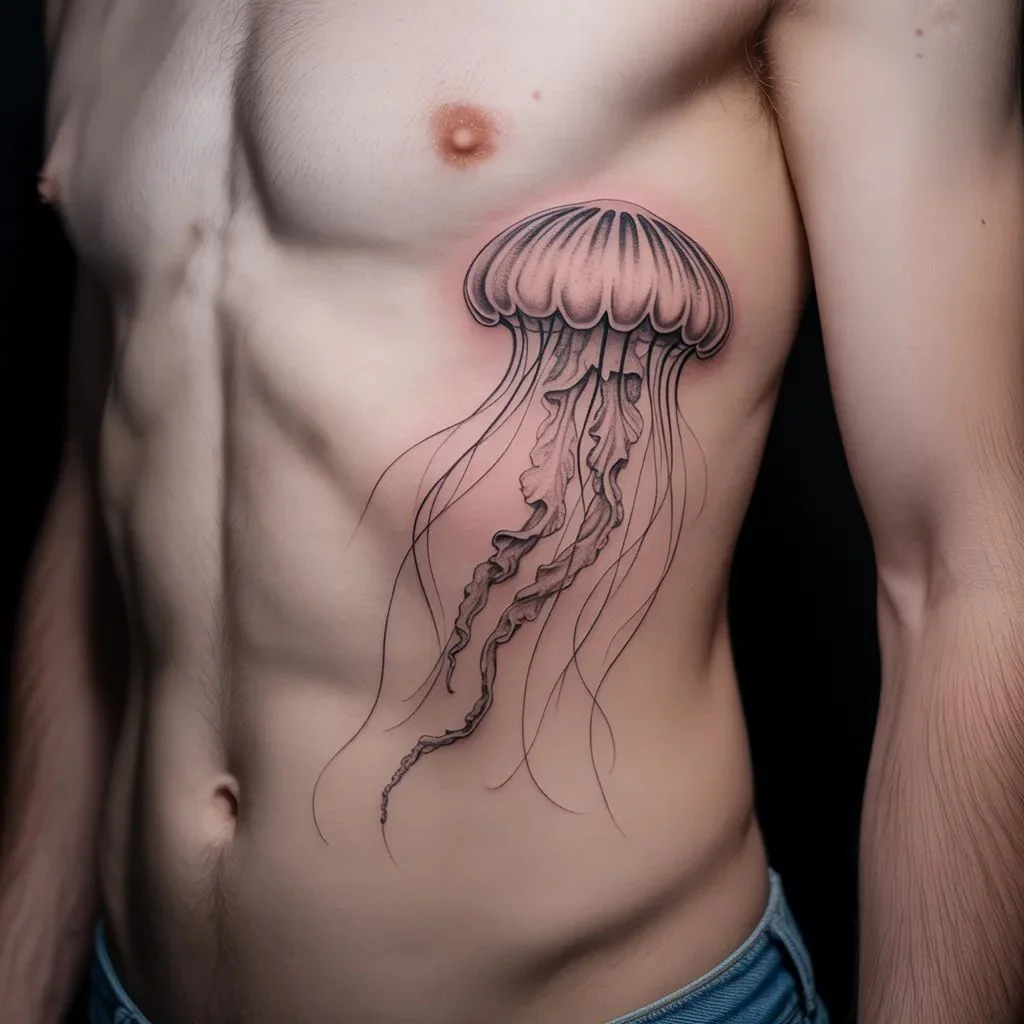
Not all jellyfish tattoo fine line styles are small and subtle. Some of the most arresting examples use the tentacles as a compositional tool — letting them drift down a forearm, curl around a ribcage, or trail along a thigh as if the jellyfish were genuinely floating across the body.
The bell sits at the top of the composition as an anchor point while the tentacles interact with the body’s natural curves and movement. When done well, the tattoo appears to move with the wearer.
This approach works best on longer body sections: inner arm, ribcage, thigh, or calf. Avoid areas with significant muscle movement that could distort the flowing lines over time.
8. Japanese-Influenced Fineline Jellyfish
Traditional Japanese tattooing celebrates ocean life with deep cultural intention. A fine line interpretation of this tradition keeps the iconography — stylised waves, foaming water, the deliberate composition — while replacing the bold outlines with delicate single-needle work.
The result bridges two worlds: the graphic power of Japanese tattoo tradition filtered through the quiet precision of modern fineline technique. This is particularly appealing to collectors who appreciate both aesthetics.
9. Bioluminescent Glow Effect Fineline
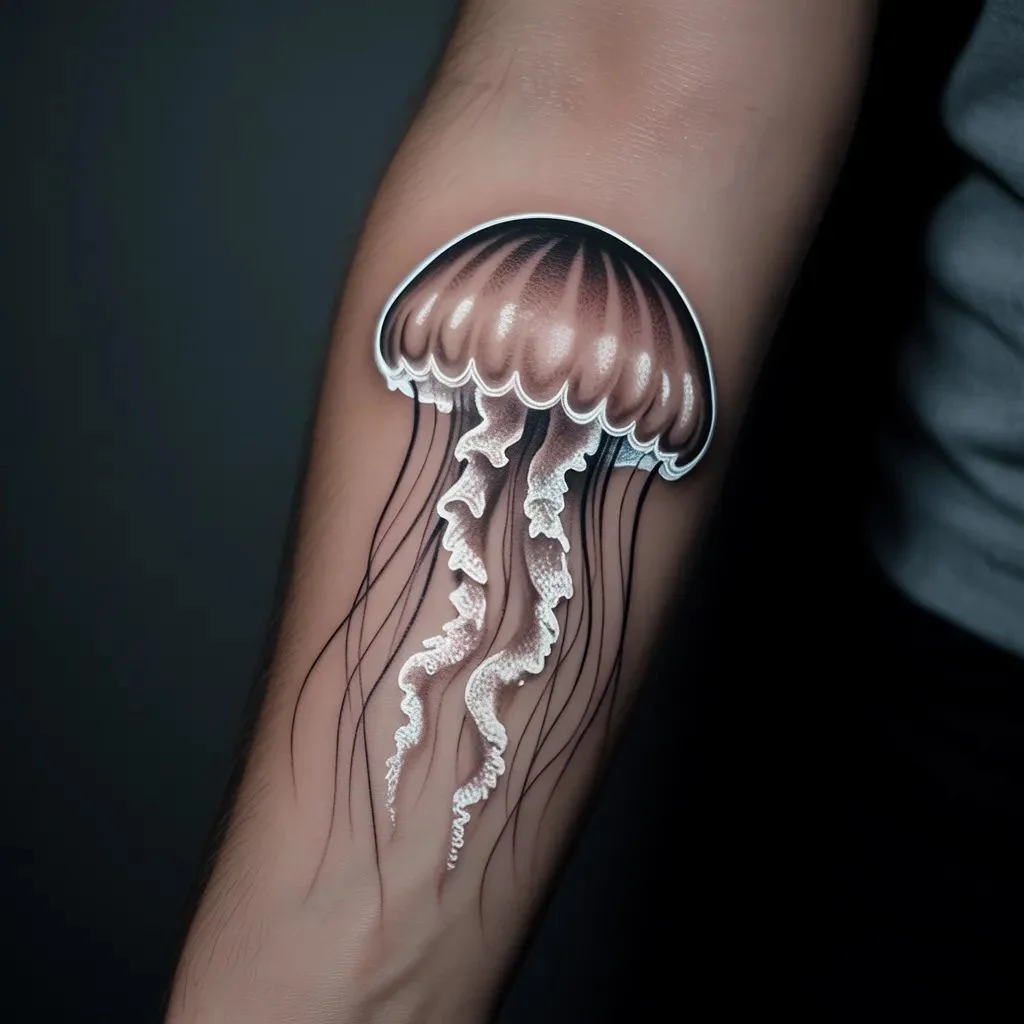
Some fine line artists create the illusion of bioluminescence using white ink highlights layered over grey wash shading. The jellyfish appears to glow from within — its bell and tentacle edges catching an internal light source that doesn’t exist but absolutely looks like it should.
This effect is most powerful on lighter skin tones where the contrast is clearest. Ask your artist whether they have experience with white ink highlight work before committing — poorly applied white ink can look grey or muddy within months.
10. Negative Space Fineline Jellyfish
In negative space designs, the jellyfish form is defined by what surrounds it rather than what fills it. Fine ink lines suggest the boundary of the creature while the inside remains as bare skin — creating the impression of a creature made of light.
This is among the most technically demanding of all jellyfish tattoo fine line styles. The artist must control exactly how much skin to leave bare, how to suggest form without filling it, and how the design will read as the skin ages and lines soften.
11. Celestial Jellyfish Fineline
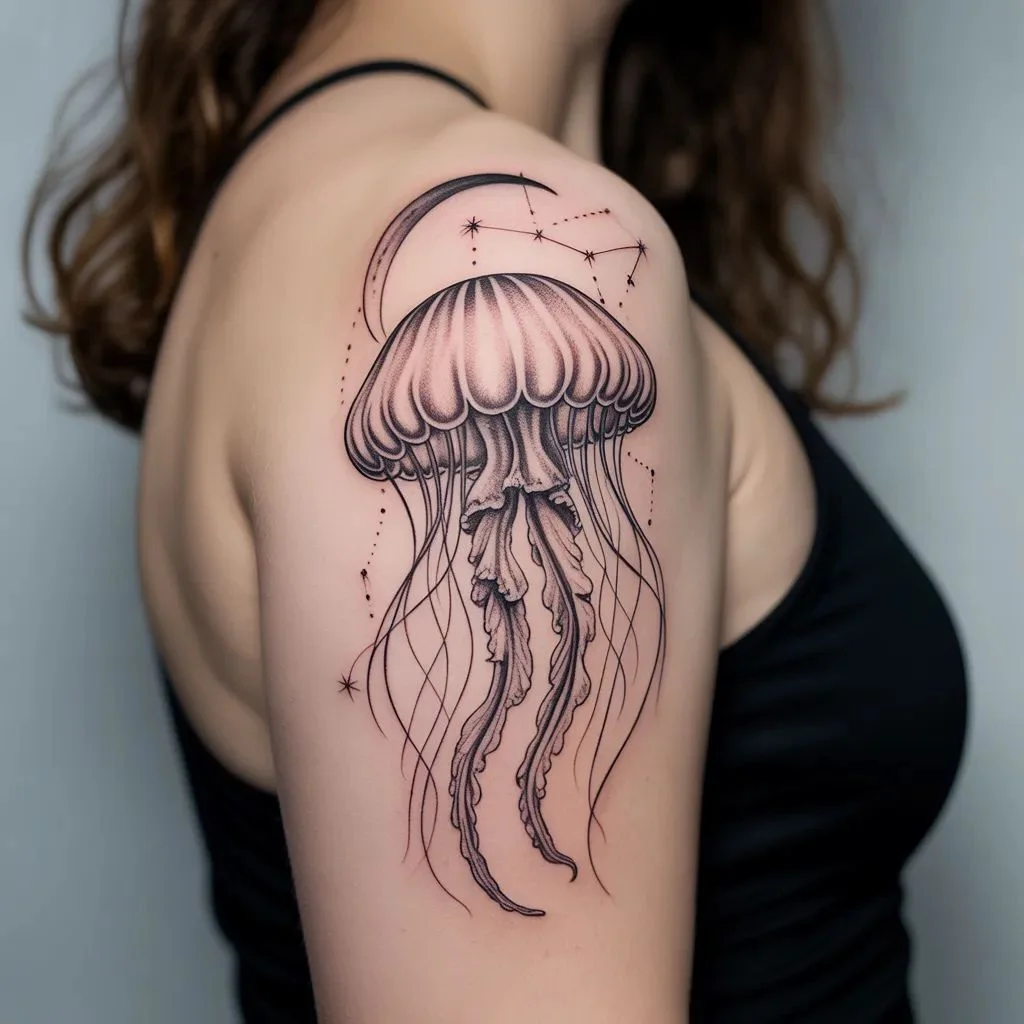
Stars, crescent moons, fine constellation lines, and Saturn-ring elements woven into a jellyfish design create something that feels cosmic and oceanic at once — two vast, mysterious environments rendered in delicate ink.
This style resonates strongly with people who feel connected to both the sea and the sky. Constellations can be chosen for personal meaning — a birth star chart, a loved one’s zodiac, or simply an arrangement that appeals aesthetically.
12. Illustrative Sketch-Style Fineline
Sketch-style fine line mimics the aesthetic of a pencil drawing — loose, gestural marks, slightly broken lines, visible hatching for shading. The jellyfish looks as if it’s been lifted directly from a naturalist’s field notebook.
This style ages particularly well because the deliberately imperfect quality means that slight line expansion over time reads as part of the design rather than degradation. It suits people who appreciate artisanal, handmade aesthetics.
13. Twin or Mirrored Jellyfish
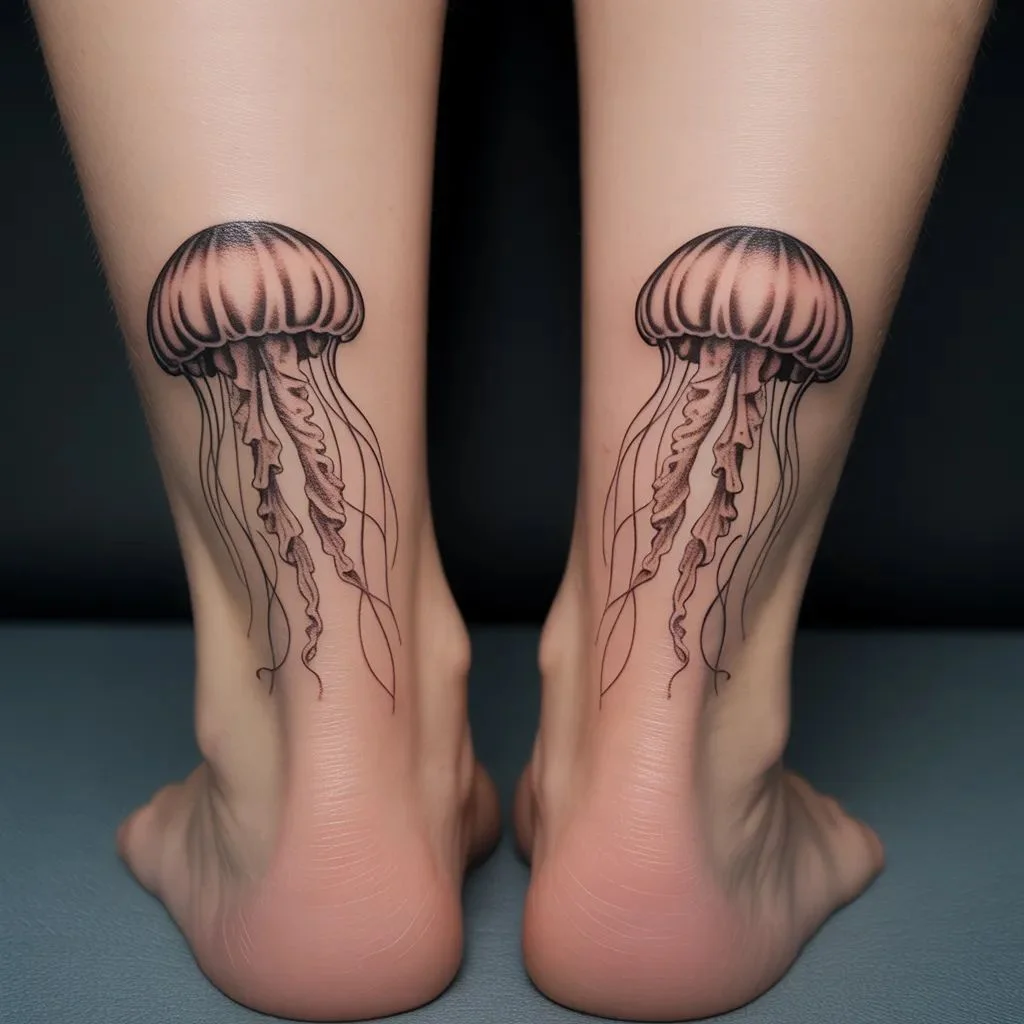
Two jellyfish facing each other — bells nearly touching, tentacles flowing outward in symmetrical trails. This design works beautifully as a bilateral piece on the collarbones, inner ankles, or backs of the knees.
The mirrored composition creates balance and visual harmony. It’s a popular choice for representing duality, partnership, or two sides of the self. Adding a subtle difference between the two — one slightly more detailed, one more abstract — prevents the design from feeling mechanical.
14. Fineline Jellyfish with Botanical Elements
Pairing a jellyfish with botanical details — sea flora, delicate fern fronds, trailing seaweed, or even land flowers like peonies or wildflowers — creates a design that bridges ocean and garden. The combination reads as unexpectedly harmonious because both jellyfish and botanicals share organic, flowing forms.
Peony-jellyfish hybrids are a particularly popular variation: the layered petals echo the structure of the bell, making the combination feel intentional rather than arbitrary.
15. Fineline Jellyfish Portrait Style
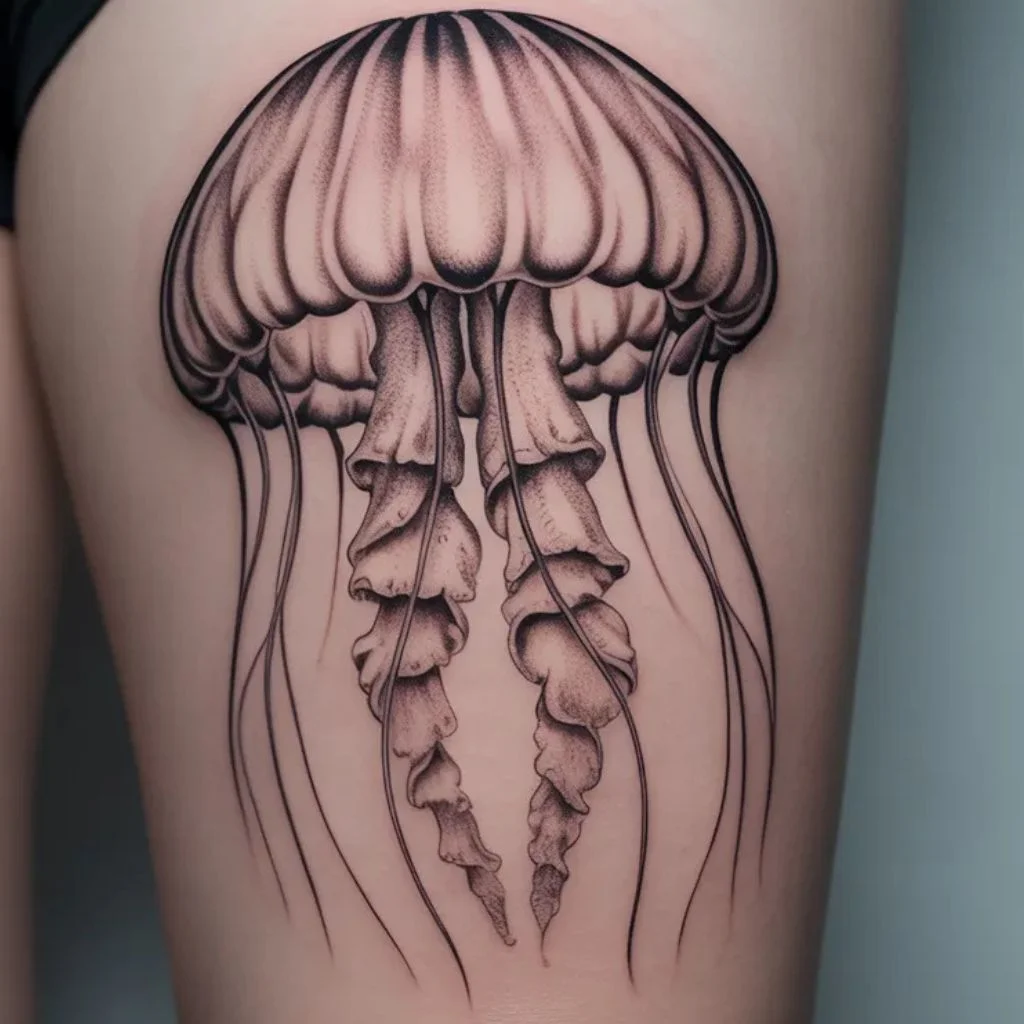
Portrait-style fine line zooms in dramatically — showing the jellyfish bell up close as if viewed through glass, internal anatomy visible, light refracting through the translucent body. This style prioritises realism above all else.
Finding the right artist for this style matters enormously. Look for artists who have executed fine detail realism work in their portfolio, specifically with organic subjects. The technical requirements are significant.
16. Fineline Jellyfish with Linework Waves
Fine parallel lines beneath the jellyfish suggest water surface movement — simple, graphic, immediately readable. This addition grounds the floating creature, giving context without adding visual complexity.
The wave lines can be highly stylised (evenly spaced horizontal lines) or more naturalistic (varied spacing, gentle undulation). Either approach works depending on whether you want a graphic or organic overall feel.
17. Fineline Jellyfish Stack or Cluster
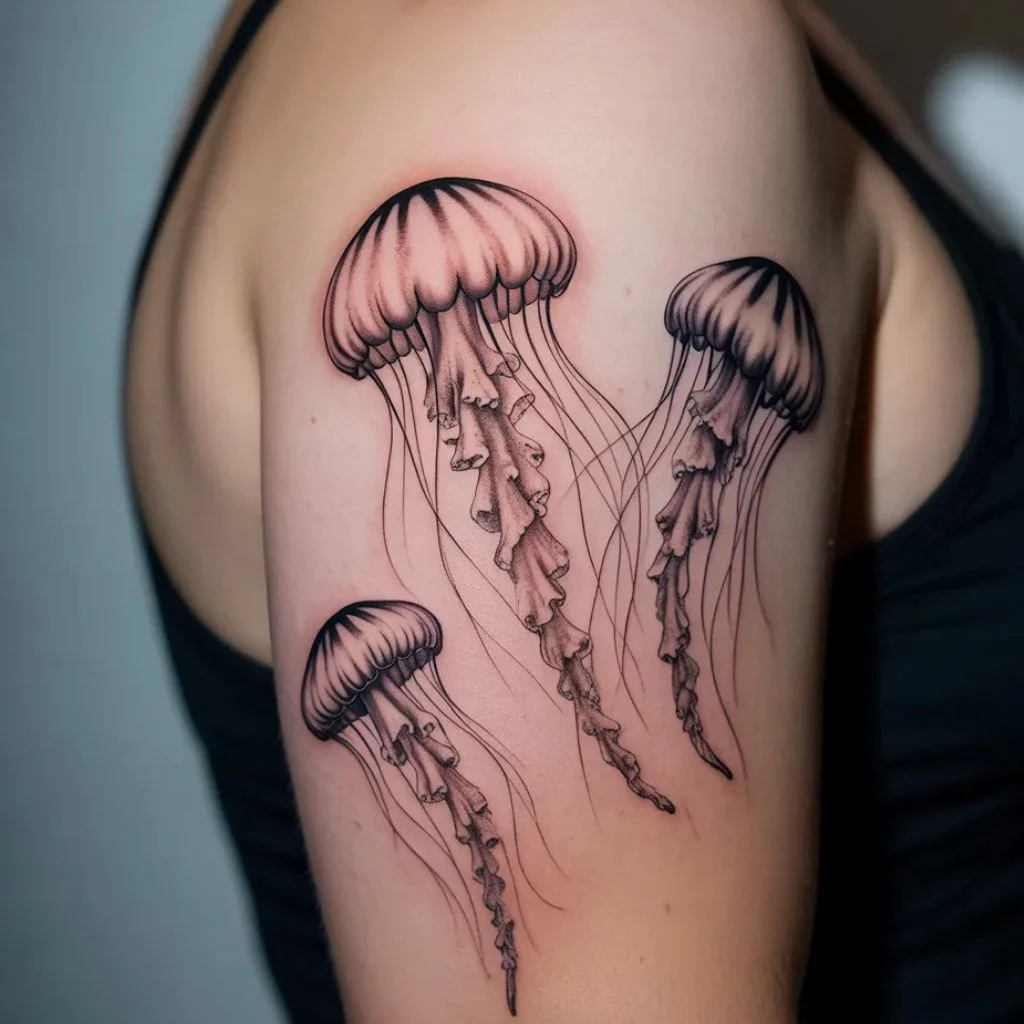
A cluster of three to five jellyfish of varying sizes, drifting in loose formation, creates a design with natural movement and narrative. The smallest jellyfish feel like juveniles; the largest, a quite elder. Together they suggest community, family, or simply the beauty of repetition.
Scale variation is critical to making this design work. If all the jellyfish are the same size, the composition feels flat. Different scales create depth and make the piece feel genuinely three-dimensional.
18. Fineline Jellyfish Moon Phase
Each phase of the moon frames a different jellyfish pose — from a tiny crescent containing a curled, minimal design through to a full circle housing a detailed, fully realised specimen. Arranged in a horizontal band across the ribs, collarbone, or spine, this design is quietly extraordinary.
The symbolism resonates: the moon controls the tides, and the ocean carries the jellyfish. The connection between celestial and marine feels earned rather than forced.
19. Abstract Expressionist Fineline Jellyfish
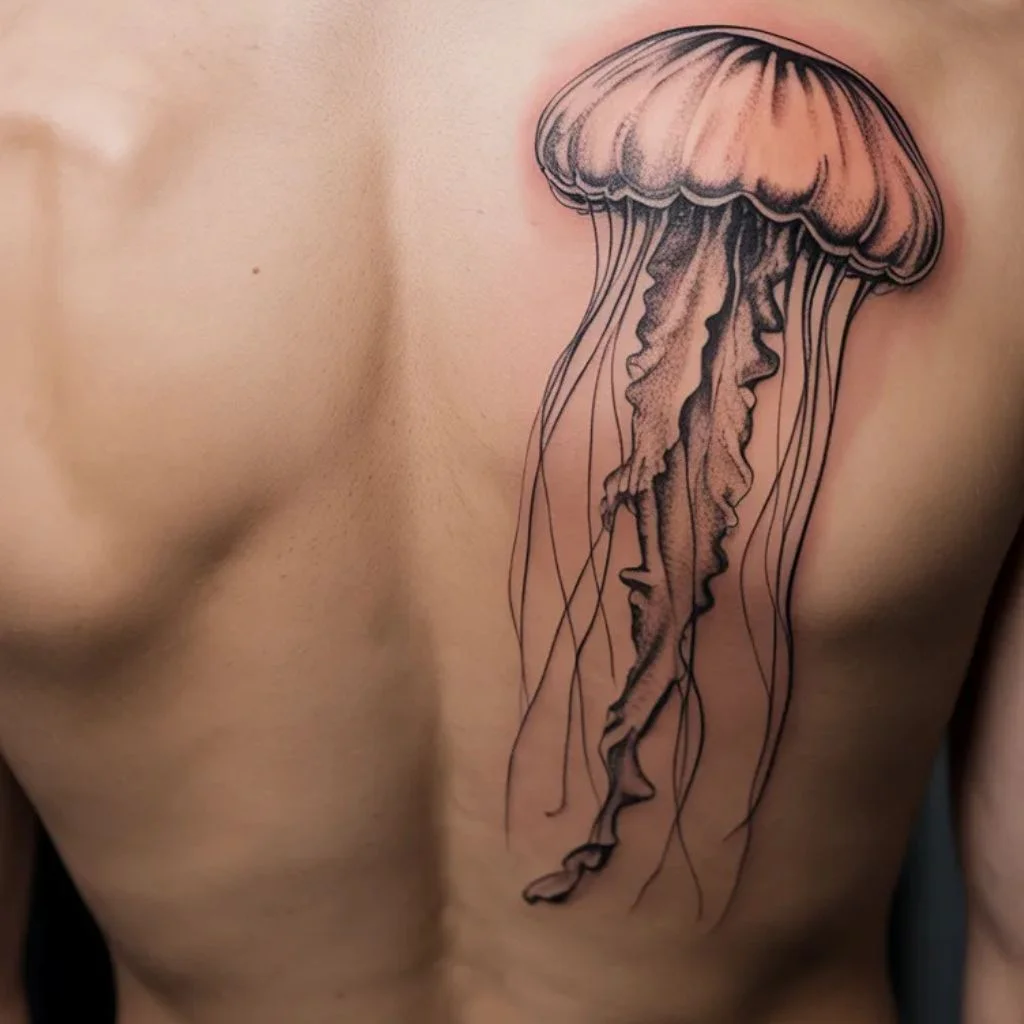
Some fine line artists work loosely — letting lines break, overlap, and extend beyond the subject to create an expressionist quality. The jellyfish is recognisable but feels like it’s dissolving into motion, as if caught mid-transformation.
This style suits people who prefer art that invites interpretation over art that delivers a finished statement. It reads differently from different angles and distances.
20. Fineline Jellyfish with Pearl and Jewel Details
Fine dot clusters, small filled circles, and tiny gem-like shapes woven into the tentacles or suspended in the water around the jellyfish add an ornamental, precious quality. The jellyfish appears to trail treasure.
This style is particularly popular with wearers who also enjoy fine jewellery — it creates a similar aesthetic of small, precious details that reward close observation.
21. Deep Sea Dark Fineline Jellyfish
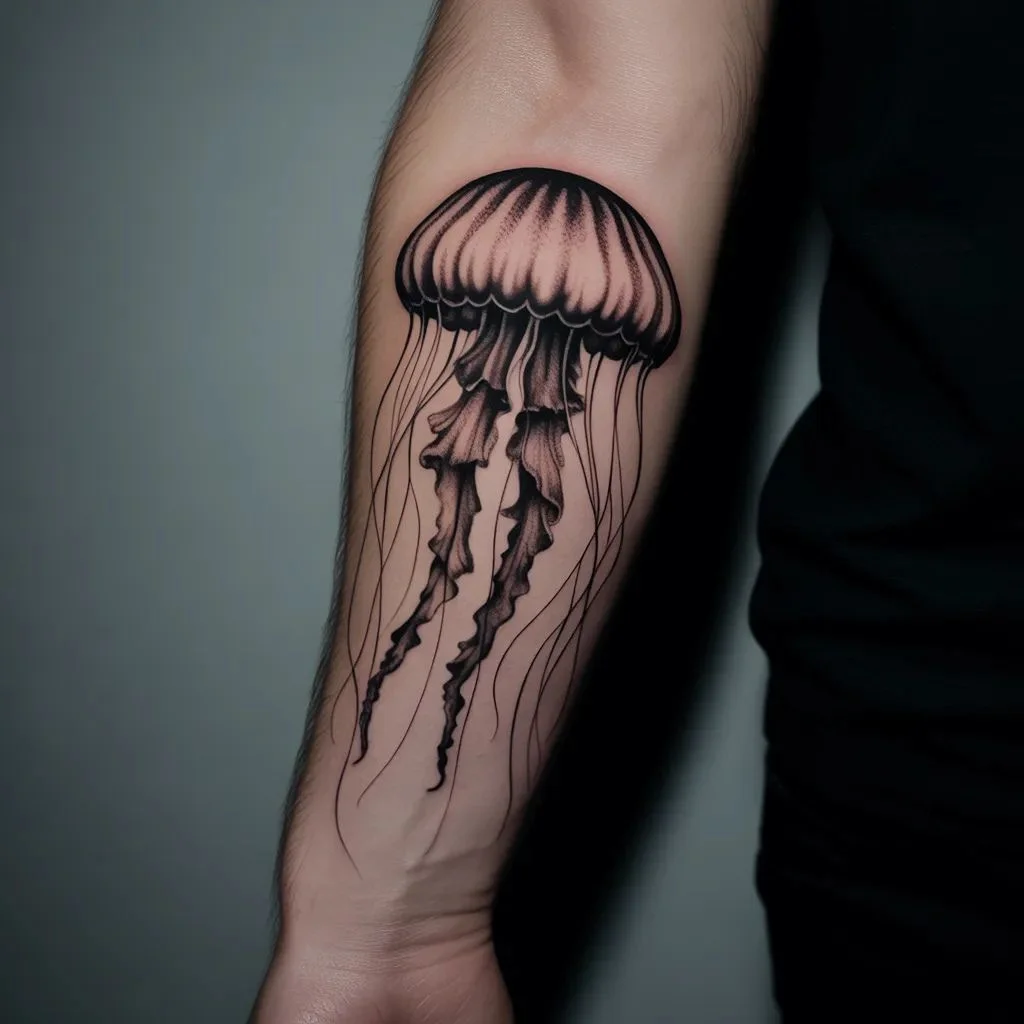
A darker, moodier interpretation — heavier grey wash fills, dramatic contrast, the jellyfish depicted as if glimpsed in lightless deep water. The bell may be almost entirely black with only fine lines suggesting its edges, while the tentacles trail into darkness at their tips.
This is a bolder version of fine line aesthetics. The darkness adds weight and drama without abandoning the precision that defines the style.
22. Fineline Jellyfish with Text Integration
Wrapping a line of script — a name, a date, a word in a favourite language, a short phrase — around or through a fine line jellyfish creates a personal design that combines visual beauty with direct meaning.
Font choice matters enormously. A fine serif or thin script complements fineline work; a heavy block font fights against it. Work with your artist on font selection rather than arriving with a screenshot from Google Fonts.
23. Sunrise or Sunset Fineline Jellyfish
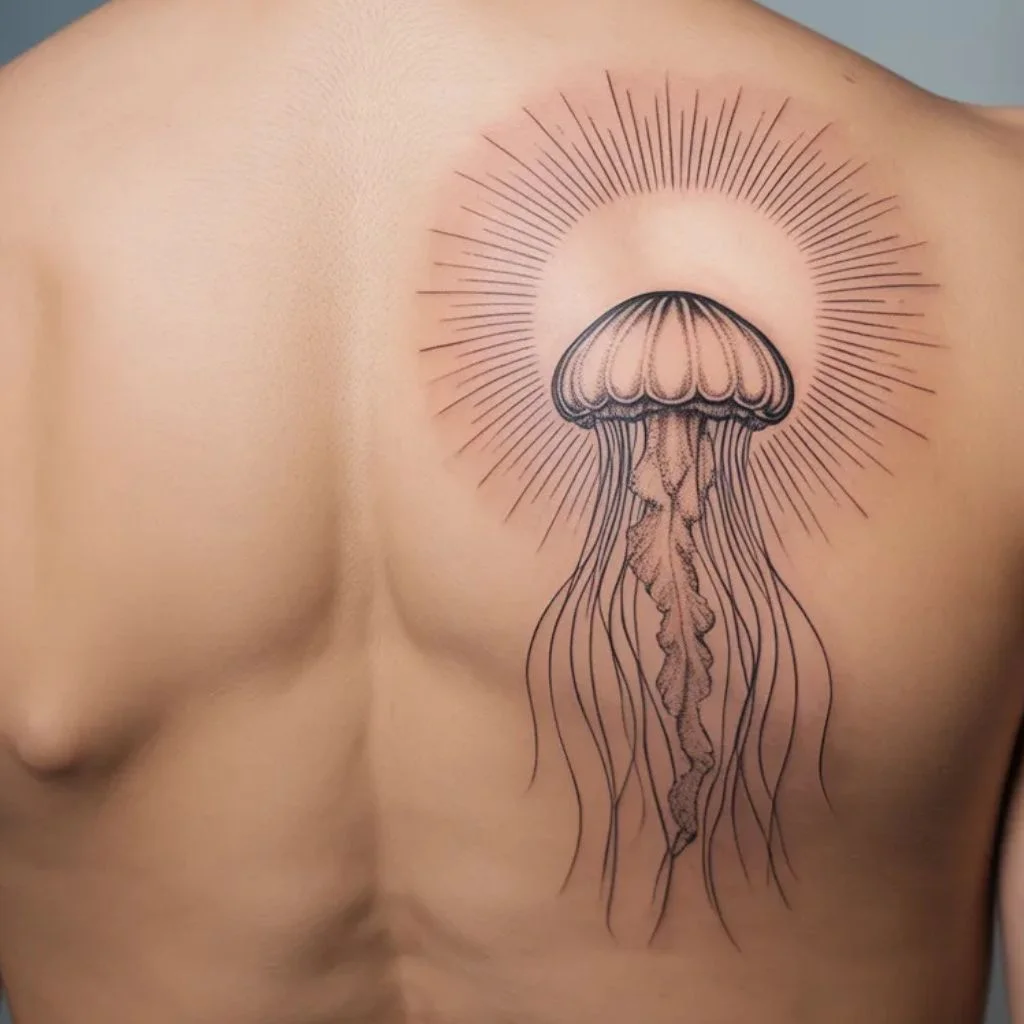
The jellyfish floats against a radiating sun — fine lines extending outward from a central point behind the bell, creating a halo or sunrise effect. The jellyfish becomes a silhouette against light, a creature of the ocean framed by sky.
This design works particularly well on the back, where the larger canvas allows the radiating lines to extend impressively. On smaller body areas, tighter, fewer rays keep the composition clean.
24. Fineline Jellyfish Mandala Fusion
The circular symmetry of a mandala and the radial symmetry of a jellyfish bell are natural partners. In this fusion style, the bell becomes the mandala’s centre — detailed, balanced, precise — with tentacles extending beyond the circular frame.
The contrast between geometric mandala precision and organic tentacle flow is the central tension of the design. It requires an artist comfortable with both forms; look specifically for examples of both in their portfolio.
25. Iridescent Colour Fineline Jellyfish
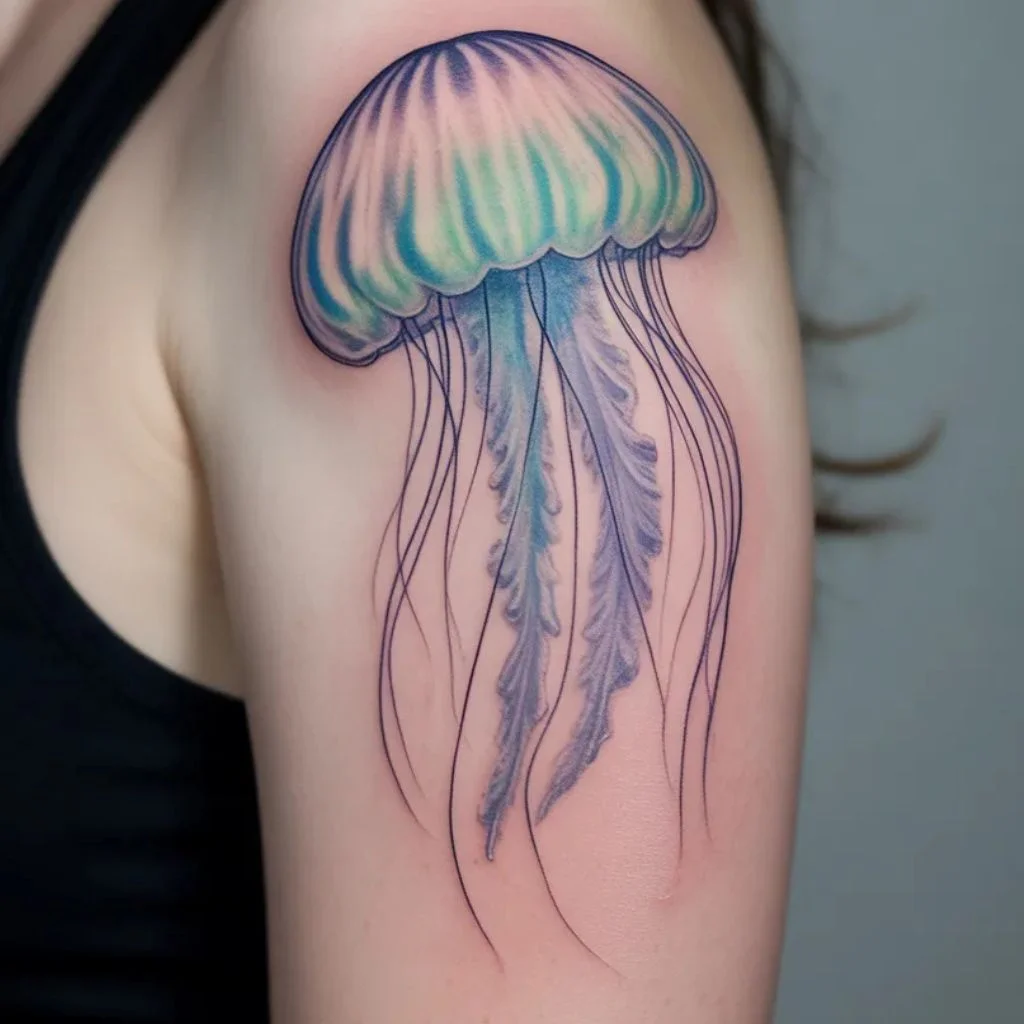
The final style in our collection uses subtle colour to mimic the iridescent shimmer jellyfish display in real life. Pale lavender, seafoam green, soft gold, and shell pink applied in translucent washes over fine line structure create a design that appears to shift colour in different lights.
This is the most decorative of all jellyfish tattoo fine line styles — unambiguously beautiful, consciously ornamental. It suits people who want a design that feels celebratory and alive.
The Ocean Calls — Your Fineline Jellyfish Awaits
Of all the creatures the natural world offers as tattoo subjects, few translate into fine line work as beautifully as the jellyfish. Its form is already art: the soft bell, the trailing lines, the quiet luminosity. Fineline technique doesn’t impose a style on it — it simply reveals what was already there.
The 25 jellyfish tattoo fine line styles in this guide range from the bare minimum of a single-needle silhouette to the layered complexity of a dot-work ornamental statement piece. Somewhere in that range is the design that will feel completely right for you.
Take your time. Research artists. Look at healed work. And when you sit down in that chair, you’ll know exactly what you want — and why.
Editor Pick: Hummingbird Tattoo Designs That Capture Grace, Colour & Symbolism.